
Key Takeaways
- Recovery follows a predictable arc, from a swollen, bruised first week through a gradual, months-long settling period, with full results visible only at the one- to two-year mark.
- The nasal tip heals more slowly than any other part of the nose because of its thicker skin and limited blood supply, so it’s normal for the bridge to look finished long before the tip does.
- Week two is often the hardest point emotionally, since bruising fades faster than swelling and the nose can temporarily look worse than it did right after surgery.
- Whether Dr. Basner uses an open or closed technique, recovery follows a similar overall timeline, with only minor differences in early tip swelling and scarring.
Rhinoplasty recovery moves in stages, and most of what patients see in the mirror during the first few weeks after rhinoplasty is not the final result. Swelling drives almost everything you notice early on, and it resolves on its own schedule: fast at first, then slower and slower for close to a year. Knowing what happens throughout the rhinoplasty recovery timeline makes the nose job healing stages easier to plan for and trust.
Table of Contents
Days 1 to 3: Splint, Swelling, and the Part Nobody Warns You About
The first three days during your nose job recovery are the hardest and the shortest stretch of the whole timeline. You’ll go home wearing a splint across the bridge of your nose, and if Dr. Adam Basner corrected a deviated septum or placed internal splints during your procedure, you may have some internal packing as well, though many patients today go without it.
Bruising and swelling after rhinoplasty peak around day two or three, and they tend to spread lower than patients expect, pooling under the eyes and along the upper cheeks. This surprises almost everyone. The nose itself often looks less swollen than the skin surrounding it.
Nasal congestion is the part that most patients underestimate going in. Breathing through your nose is limited or impossible for the first several days, so you’ll breathe through your mouth, which can dry out your throat and disrupt sleep. Sleeping with your head propped up on two or three pillows, or in a recliner, keeps swelling down and makes those first nights more tolerable. Cold compresses around (not on) the eyes help with bruising in the first 48 hours.
Pain is usually milder than patients anticipate. Most describe pressure and congestion as the dominant sensations rather than sharp pain, and the prescribed medication manages it well. Some numbness across the tip and along the sides of the nose is normal at this stage and can linger for months.
Week 1: Splint Removal and the First Look
Around day five to seven, Dr. Basner removes the splint at a follow-up visit. This is a milestone patients look forward to, and it’s also the moment we prepare them for most carefully, because the nose underneath the splint is still substantially swollen.
Your nose at splint removal will look wider and rounder than your final result, particularly at the tip and bridge. Bruising under the eyes is usually fading to yellow-green by this point and clears within another week or so for most patients. This is not the shape you’ll be living with. It’s the form your nose takes on its way to the shape you’ll eventually enjoy.
Most patients take a full week off work or school to get through this stage, since visible bruising and swelling are still present even after the splint comes off. Makeup can cover most residual bruising by the end of week one for patients who want to return to normal activities sooner.

Weeks 2 to 4: Back to Life, Still Swollen
By the second week, the obvious signs of surgery start fading. Bruising is typically gone or nearly gone, and most patients feel comfortable returning to work and school, and easing back into low-key social situations. This is also, honestly, the hardest week emotionally for a lot of patients. The splint is off, the bruising is fading, but the swelling hasn’t caught up yet, and the nose can look asymmetric or simply “not right” in a way that’s discouraging if you’re not expecting it. We tell patients this dip is normal and temporary, not a sign that something went wrong.
Some patients notice their nose looks larger right away, particularly right after the splint comes off. This isn’t your surgical result. It’s swelling that sits on top of the new underlying structure, and it settles as the weeks pass.
Light activity and walking are fine during this window, along with most nonstrenuous daily tasks. Bending over, heavy lifting, and anything else that raises blood pressure or risks a bump to the nose should still wait. Glasses that rest on the bridge need to be taped up or avoided through roughly week four to six, since direct pressure on a healing nasal bone can shift results. Numbness at the tip is common during this period and can take months to fully resolve, which is a normal part of nerve healing after the tissue is repositioned.
Months 2 to 3: Subtle Refinement and Return to Exercise
By eight to twelve weeks, most patients look like themselves again to everyone but the surgeon and, often, themselves. Swelling has resolved enough that the nose looks close to its final shape in casual conversation and in photos, though it’s still refining underneath.
This is generally when Dr. Basner clears patients for full exercise, including higher-impact cardio and, with some caution, contact sports, though anything with a real risk of a blow to the nose warrants extra care for several more months. Sweat and increased blood flow from exercise can cause temporary swelling that looks alarming after a workout but settles within a day.
Subtle changes are still happening at this stage, even though they’re harder to notice week to week. The skin is continuing to redrape over the underlying structure, and small asymmetries or areas of firmness are often still present, especially at the tip.
Months 6 to 12: 80 to 90 Percent There
Most of the visible swelling, roughly 80 to 90 percent of it, has resolved by the six-month mark, and the difference between month six and month 12 is much smaller than the difference between month one and month six. Patients often describe this stretch as watching the nose “settle in,” with the tip narrowing slightly and definition sharpening month over month.
Firmness at the tip is common throughout this window, particularly for patients who had significant tip work or a septorhinoplasty (a combined procedure that also treats a deviated septum). This firmness is residual swelling and scar tissue maturing, not a permanent feature, and it continues to soften over the following months.
The 1 to 2 Year Mark: Final Results
If you’re wondering, “How long does rhinoplasty take to heal?” full, final results take one to two years, and the nasal tip is almost always the last area to finish healing. Because the tip has thicker skin and less blood supply than the rest of the nose, it holds on to swelling far longer than the bridge or sidewalls. If your bridge looked finished by month four but your tip still felt slightly firm or looked slightly rounded at month eight, that’s the expected pattern, not a concern.
Once you reach the one to two year mark, the result you see is the one you’ll have long term, barring the ordinary effects of aging on facial skin and tissue over decades. To give a sense of how the changes look in real patients from surgery through full healing, our rhinoplasty before-and-after gallery shows a range of cases and outcomes.
Does Recovery Differ Between Open and Closed Rhinoplasty?
Patients frequently ask if the surgical approach changes the recovery experience, and the honest answer is: somewhat, though less than most people expect.
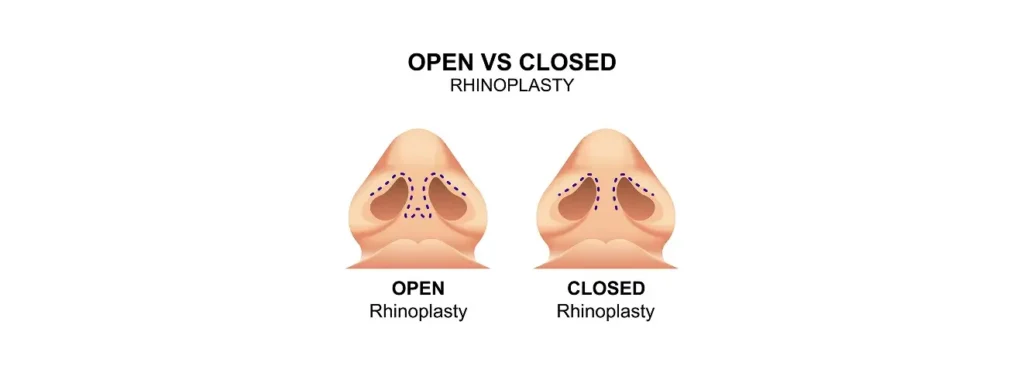
Closed rhinoplasty places all incisions inside the nose, so there’s no external scar. Swelling and bruising patterns are similar to those of the open technique, though some patients report slightly less initial swelling because the skin envelope isn’t lifted as extensively.
Open rhinoplasty adds a small incision across the columella, the strip of tissue between the nostrils. This gives Dr. Basner direct visibility of the nasal structure, which is valuable for more complex cases, revision surgery, or significant tip reshaping. The columellar incision heals well and typically fades to a thin, barely visible line within several months. Patients undergoing the open technique often see slightly more tip swelling in the first few weeks since surgery lifts the skin more fully to reach it.
Neither approach is inherently better. Dr. Basner selects the technique based on your specific anatomy and goals, and he’ll walk you through which approach fits your case and what that means for your recovery during your consultation.
What Patients Usually Get Wrong About Recovery
A few things about the rhinoplasty healing timeline surprise nearly every patient, even those who did their research beforehand.
Numbness lasts longer than expected. Tip numbness is normal and can persist for six months or longer in some patients. It’s a nerve response to tissue repositioning, not a complication, and sensation returns gradually.
Week two is an emotional low point. The bruising is gone, but the swelling isn’t, and the nose can look worse in some ways than it did at week one. This is the point where patients worry most about their decision, and it’s also the point furthest from an accurate picture of the outcome.
Sleep restrictions run longer than most patients plan for. Sleeping with your head raised for two to three weeks, sometimes longer for comfort, is standard, and side-sleeping should wait until Dr. Basner clears it, typically around the one-month mark, to avoid shifting the healing structure.
The changes keep happening long after you feel “recovered.” Patients often mentally close the book on recovery around month three, once swelling is subtle and life is back to normal. But the nose is still refining for another nine to 15 months after that, particularly at the tip.
The total rhinoplasty recovery time follows the same broad pattern as most facial procedures Dr. Basner performs: an early bruising phase, then a middle stretch of subtle swelling, then a longer tail of fine refinement. Our general recovery guide walks through how this compares across facelift and eyelid surgery, as well as other procedures, if you’re weighing more than one. If pricing also factors into your planning, our nose job cost guide breaks down what goes into rhinoplasty pricing in Baltimore.
Rhinoplasty Considerations
Learn about all the factors that affect Dr. Basner’s choices during your rhinoplasty procedure.
Plan Your Rhinoplasty Recovery With a Surgeon Who Tells You the Truth
The best way to know what your rhinoplasty recovery will look like is to have Dr. Basner examine your anatomy and walk you through a timeline built around your specific procedure. He’s one of a small group named by Newsweek as the best rhinoplasty surgeons in America, and he brings that same standard of care and honesty to every rhinoplasty consultation. Schedule a consultation to talk through your goals and get a recovery plan specific to you.
Frequently Asked Questions About Rhinoplasty Recovery
Is rhinoplasty recovery different if I had a deviated septum corrected at the same time (septorhinoplasty)?
Septorhinoplasty recovery follows a similar external timeline, but internal healing takes a bit more attention. You may have internal splints or light packing for the first several days to stabilize the septum Dr. Basner repaired, and nasal congestion in the first week or two can feel more pronounced since both the septum and the external structure are healing at once. Functional breathing improvement is often noticeable within a few weeks, well before the cosmetic result has fully settled.
How soon can I fly after rhinoplasty?
Most patients can fly two to three weeks after surgery, once acute swelling has decreased and Dr. Basner has cleared them at a follow-up visit. Cabin pressure changes can temporarily increase nasal swelling and congestion, so patients flying in the first month often find a decongestant helpful.
Will insurance cover any part of my rhinoplasty recovery, like medication or follow-up visits?
Cosmetic rhinoplasty is typically not covered by insurance, but if a functional issue, such as a deviated septum, is corrected alongside the cosmetic work, the functional portion of the procedure and its related follow-up care may be eligible for partial coverage. Financing is also available, and our staff can walk you through your options.
Related Articles
- Category: Rhinoplasty

What Is Facelift Surgery? Your Total Guide To Getting A Facelift
Getting older is no fun. Especially when we look in
Is Your Nose Making You Look Older?
Rhinoplasty offers many benefits and is a common requested procedure
Mini Facelift vs. Full Facelift: Recovery, Results, and Costs Compared
Aging is inevitable, but looking older than you feel? That’s